Exploring Emerging America’s Windows on History Program
Since 2006, Emerging America’s Windows on History program has mobilized more than 30 research teams of K-12 students with their teachers and in partnership with historical societies, museums, town and college libraries, expert individuals, and other very local resources. Students learn to think historically as they track down primary sources to tell the story of their communities and their place in the world.
"What is the dog doing there? It really would run away when it heard the guns fire. So why did Paul Revere put it in the picture? Well, most people like dogs. So we think he wanted people to take the side of the Americans by thinking, 'Those mean British are shooting at a dog!'" - Fifth graders, Morgan Elementary School, Holyoke, Massachusetts
Exploring Emerging America’s Windows on History Program
Since 2006, Emerging America’s Windows on History program has mobilized more than 30 research teams of K-12 students with their teachers and in partnership with historical societies, museums, town and college libraries, expert individuals, and other very local resources. Students learn to think historically as they track down primary sources to tell the story of their communities and their place in the world. This is the third in our series of close-ups on these sites.
Teachers Karen McKay and Caroline Allison first posted these ideas as part of the Emerging America Library of Congress Teaching with Primary Sources Training of Trainers program.
Last summer, a distressed teacher friend shared an all too common story. Throughout the school year, she had sparked students’ skills and passions with a cross-curricular exploration of slavery. It was heady, demanding, and bang-on target for both state content standards and her 4th graders’ interests in fairness, difference, and understanding where we come from. At year’s end, her principal congratulated her overall success in boosting academic skills. Yet he added, “I’m concerned about the time you spent on social studies.
Fourth and fifth grade students at the Hilltown Cooperative Charter School published their research at: Colonial Voices of Williamsburg. The site lays out students' entire path of discovery, including: photos and discussions from visits to local archives, student-created traditional Colonial floor cloths, a historical timeline, and ultimately, the gravestone of Master, Jonathan Warner.
Document Excerpt: …Bind the aforesaid John Curtis with his consent Apprintice to Jonathan Warner of Williamsburgh in the County of hampshire Yeoman to learn his art trade or mystery being a house Carpenter or Joiner after the manner of an apprintis to Serve him from the day of the Date hereof for and During the full term of four years three months and twenty days…
Students began their investigation into a 1771 indenture document at the Williamsburg, Massachusetts Historical Society. Having seen the real thing, they knew where the document came from and when. Now they gave it a close reading, picking out characteristics (old yellowed paper, stained, old-fashioned cursive, lots of signatures, probably a legal document). Once they figured out that it bound an apprentice to his master, they explored what the master had to do (teach a trade, and provide him with room and board) and what the apprentice had to do (obey) and not do (marry, leave, gamble, drink, etc.). Students discussed what these obligations might say about social relations in the era. Then they brainstormed where they could find out about these two people and their era.
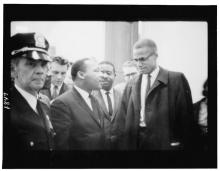
In Fairbury, Nebraska–pop. 5,000–where I grew up in the 1960s, there lived literally zero black people. It was not by chance: the Klan and its allies had driven blacks out of much of the rural Midwest. (My parents' Civil Rights advocacy found scant welcome in my home town. But that's another story.) When I was in 6th grade, my older, wiser brother (a 9th grader) handed me the Autobiography of Malcolm X and set me on a journey that compels me still. More recently, two scholars in our Teaching American History (TAH) program reset my world view as powerfully as my brother did back in 1971.
Guest Post: Rusty Annis, Belchertown, Massachusetts, Teacher
World War II marked a watershed for American identity, equality and opportunity. Advocates called bastions of racism into question and for the first time effectively challenged many aspects of discrimination. The war gave minorities (including women) a chance to contribute in a noticeable way to American society. It was not an easy transition. Horrifying reactions occurred.
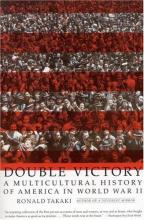
Axis propagandists used America racism to knock America off its high horse of moral superiority. An excellent book utilizing personal accounts from this time period is Double Victory, by Professor Ronald Takaki (Back Bay Books, Little, Brown and Co. New York). Takaki gives an overview of many ethnic stories of striving for American identity. The phrase double victory refers to a February 7, 1942 letter to the editor of the Pittsburgh Courier from James G. Thompson, encouraging equality for people of color in the United States. “The first V for victory over our enemies from without, the second V for victory over our enemies from within.” Link to a wiki on the impact of the Double Victory Campaign. (The "Double V for Victory" button by the page title leads to a unique large photo of a Double V rally.)
Since before the American Revolution, it has been common knowledge in Western Massachusetts that there lies a tension between the wealthy centers of farming and trade along the Connecticut River and the steep, rocky, and isolated "Hilltowns." Yet these small towns, like communities everywhere, have sometimes played outsized roles at key turning points of our nation's history.
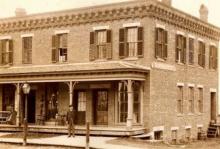
Over the winter of 2010-2011, Dawne Piers-Gamble's eighth graders at Gateway Regional Middle School, in Huntington, Massachusetts set out to uncover and publish some of those stories at: Gateway Hilltown History. In addition to a host of primary sources, such as census data, maps, town histories, employment data, and images such as the one displayed here, students pored over such secondary sources as a 1982 Historical Commission survey, a 2004 study of New England mill towns, and a 1916 History of Paper Manufacturing. Students also hiked part of the route of the Boston to Albany Railroad and interviewed historical reenactors. Here are a few highlights from their retelling of this multi-layered American tale: