

Disability History for Emerging Educators
Building Opportunities for Teacher Education Students to Engage with Disability History
Growing up, many of us did not have an opportunity to learn about disability history as part of our traditional K-12 curriculum when we were students. (We –the authors–did not learn about it until graduate school.) As adults and teachers, it can feel discouraging and potentially overwhelming to feel like we are lacking a foundation of knowledge to draw from–despite having an intention to learn and a desire to share it with students.
As teacher educators* whose courses range from early childhood to graduate special education, we have made a concerted effort to include content related to disability history throughout our coursework. We have found that by including the stories, concepts, and efforts of so many people connected to disability history and advocacy, past and present, our students understand and make connections to important ideas with greater depth and increased empathy. It did not happen all at once, but over time, we found ways that we could add a reading here, a video clip there, an online professional development training assignment, a movie reflection… and before long, there were intentional opportunities for students to engage with disability history content throughout the semester.
"Before long, there were intentional opportunities for students to engage with disability history content throughout the semester."
For example, when we co-taught a course for undergraduates focused on observation, assessment, and intervention, we asked students to read a one-page essay from Janice Fialka (2005), Changing the Way We Think. Though over 20 years old, its messages resonated with undergraduates. To deepen their understanding, we led discussions situating the essay within a historical context, and students were able to make connections to family experiences with disability, assessment, family-professional partnerships, Individuals with Disabilities Education Act (IDEA) law, and Anne Donnellan’s idea of the “least dangerous assumption.” From that point forward, the class had a shared vernacular and reference point that we returned to time and again as the semester progressed.
The resources below are just a starting point, not a definitive list, and any omissions are not intentional. They have, however, given us the ability to support our students and meet them where they are by offering choices in different types of media and interest areas, while helping us all to continue learning.
*Authors’ note: we are teacher educators and make no claim to be experts in disability studies or disability history. We continue to learn from others with expertise in these areas and offer gratitude for those whose work and advocacy has taught us so much.
Nancy Farstad Peck, PhD and Lance S. Neeper, PhD
Keene State College
Keene, New Hampshire
Disability History Resources for Teacher Education Classes
Video Options
Overviews
- A Brief History of Disability Rights in the United States; UMass, Office of the President.
- Disability History: An Introduction. (10:58 minutes). Disability & Philanthropy Forum.
Documentary Films
- Crip Camp. (2020). (106 minutes). Netflix.
- Lost in Laconia. (2010). (60 minutes). 1L Media.
- Full Circle. (2023). Netflix. Level 1 Productions.
- Willowbrook: The Last Great Disgrace. (1972). (27:20 minutes). Geraldo Rivera.
- Including Samuel. (2007). (57:12 minutes).
- The Ride Ahead. (2025). (90 minutes). POV. PBS.
- Intelligent Lives. (2018). Dan Habib.
- Other Films by Dan and/or Sam Habib. Like Right Now Films.
Short Films
- A Good Life, Too. (2013). (4:18 minutes). Alonzo Clemens.
- My Kid the Rockclimber. (2018). (5:42 minutes). Kellan Tilton. Fatherly.
- Stella Young’s TED Talk: "I am not your inspiration, thank you very much." (2014). (9:16 minutes). TED.
Print Options
Literature Collections
- Dolly Gray Children’s Literature Award. Celebrating Characters with Autism and Developmental Disabilities in Children’s Books.
- IRIS Center Literature Collection. Vanderbilt University.
- List of Recommended Children's Books on Disability. Emerging America.
Children’s Literature
- Mama Zooms. Jane Cowen-Fletcher.
- This is How We Play: A Celebration of Disability and Adaptation. Jessica Slice and Caroline Cupp. Illustrated by Kayla Harren.
- Same, Same but Different. Jenny Sue Kostecki-Shaw.
Middle Grades and Young Adult Literature
- List from Boston Public Library.
- List from Social Justice Books. (Searchable by age range).
Family Perspectives and Resources
Helpful Websites
- Emerging America.
- Disability History Museum.
- Library Collection: Christmas in Purgatory by Burton Blatt.
- Understanding the Who Before the How. UMass Office of the President.
- Disability Minnesota.
Professional Development Resources
- CONNECT Modules and DEC.
- Council for Exceptional Children.
- DEC Learning Deck Webinars.
- IRIS Center, Vanderbilt University.
- PACER CENTER.
Citations
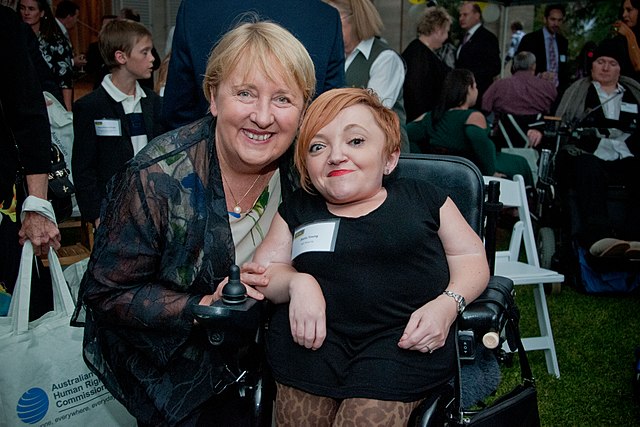
- Photo of Jenny Macklin and Stella Young at AHRC event. (2013). Australian Human Rights Commission. Wikimedia Commons.
- Cover of Same, Same but Different. Jenny Sue Kostecki-Shaw.
- Fialka, J. (2005). Changing the Way We Think. Everyone Together. Volume 1, Issue 2. https://www.danceofpartnership.com/ChangingtheWayWeThink011907.pdf.
- Donnellan, A. M. (1984). The Criterion of the Least Dangerous Assumption. Behavioral Disorders, 9(2), 141–150. http://www.jstor.org/stable/43153291.
